
Core Technology
Information on the CLPS-LIMS core technology
The CLPS-LIMS instrument is based on Laser Ablation Ionisation Mass Spectrometry (LIMS), an experimental technique that has been continuously developed by the University of Bern (UBE) for more than two decades. It enables the in-situ chemical analysis of solid materials, identifying both element and isotope compositions down to trace levels (parts per million, and for some elements, even lower).
At its core, the system features a compact reflectron-type time-of-flight (R-TOF) mass analyser, as small as 160 mm × Ø 60 mm, operating in a vacuum environment.
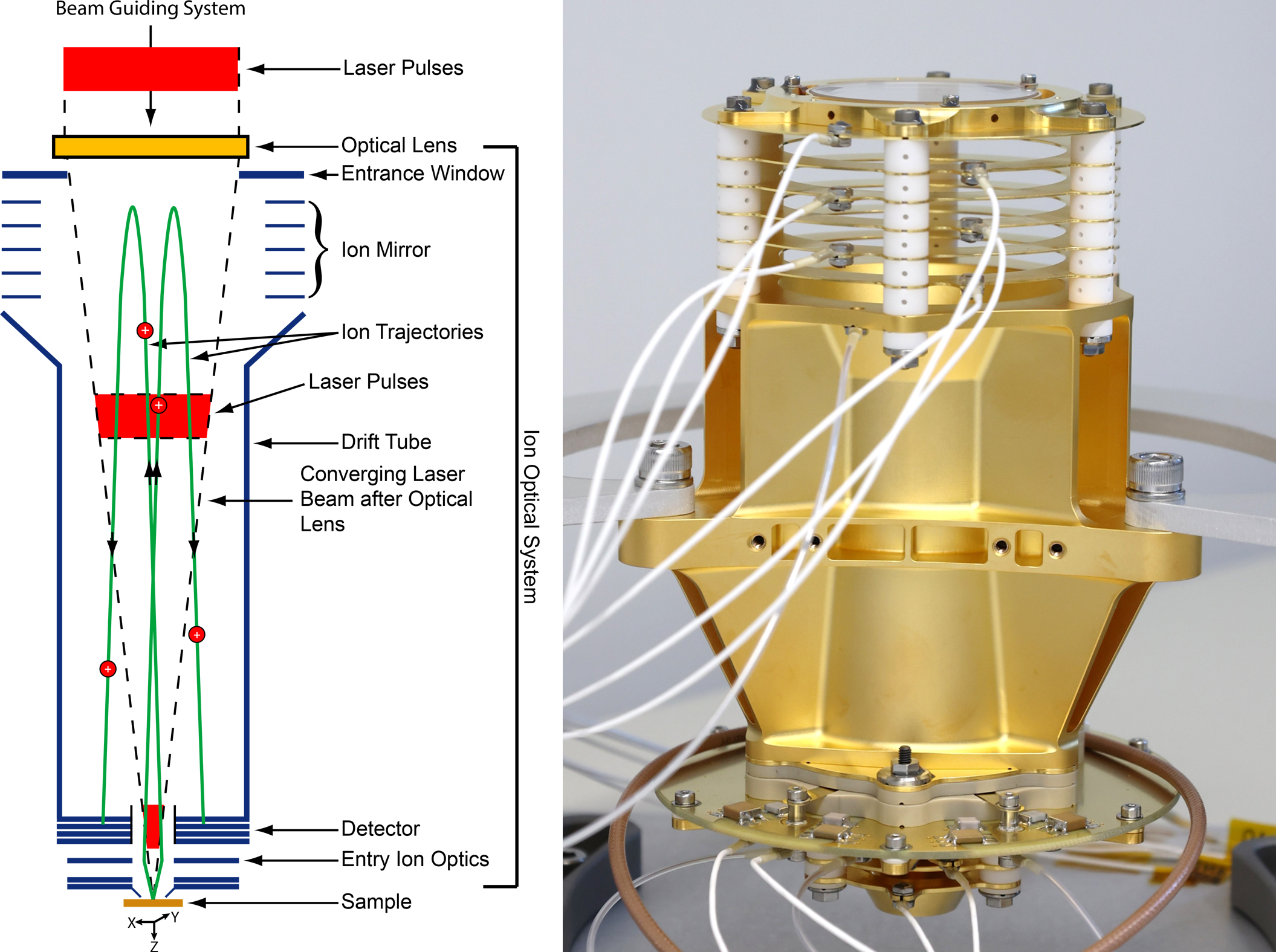
The compact R-TOF is paired with a miniature pulsed microchip laser that emits nanosecond pulses at a wavelength of 532 nm (pulse width ~1.3 ns, repetition rate 100 Hz). These pulses are guided and focused onto the sample surface to spot sizes of about 20 μm in diameter, generating irradiances from MW/cm² to GW/cm². These high laser irradiances initiate material ablation, partial atomisation and ionisation is initiated.
In the current LIMS design, positively charged species enter the ion optical system of the mass analyser. After acceleration and focusing, ions pass through a drift tube where mass-to-charge separation occurs. They are then reflected by an ion mirror and pass through the tube a second time before reaching the detector. The charged species arrive at the detector system sequentially according to their mass-to-charge ratio, enabling the sample to precisely chemically identified.