
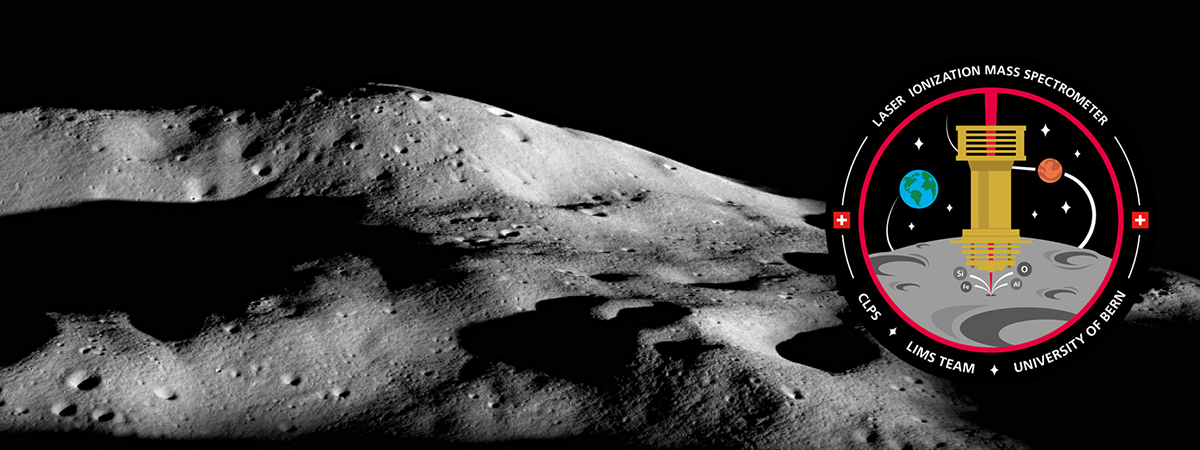
Following the successful deployment of the Solar Wind Collector (SWC) instrument by the University of Bern – at that time the only non-US science team to participate in NASA’s first Apollo 11 mission to land on the lunar surface in 1969 – it is now its time for Bern’s second instrument: a sensitive Laser Ablation Laser Ablation Ionization Mass Spectrometer for the chemical composition analysis of lunar regolith at the lunar south pole.
Selected by NASA in 2021 under the Commercial Lunar Payload Services (CLPS) initiative, which is part of NASA's Artemis program, the Laser Ablation Ionization Mass Spectrometer (CLPS-LIMS), developed by the Space Research and Planetology Division of the Physics Institute at the University of Bern, Switzerland, will be part of the payload suite of the Blue Ghost Mission 4 lander (Firefly Aerospace, NASA’s CLPS Task Order CS-6), with a target landing date late 2029.
CLPS-LIMS is designed to analyse the element and isotope composition of lunar regolith dust in situ. Using laser ablation ionization and mass spectrometry, the instrument will characterize the geochemical makeup of the Moon’s surface material, supporting investigations into lunar resource potential and surface processes relevant to future exploration activities.